We never use AI to write anything on this site.

truth not trickery
We never use AI to write anything on this site.
truth not trickery

This site does not promote any political party or viewpoint. But when people of any political persuasion make theological assertions it is important to evaluate them- because we want truth not trickery.

Society's "fig-leaf of decency" has been withering at an accelerated pace under the Trump Presidency. Are Christians aware of the likely consequences for our persecuted brothers and sisters?
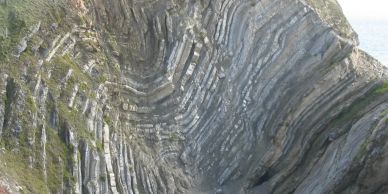
What do the rocks tell us about creation? Why is the Lulworth Crumple crumpled, (picture above) but the Cascade de l'Arpenaz is backed by a smooth curve? What light does the humble Swiss Roll shed on the creation of the world?

Each generation likes to think of itself as wiser than the ones before it. But the ancient Doom Painting at St Thomas' church Salisbury might just surprise you.

Which came first- the chicken or the egg? If that's a knotty problem, how about this one- which came first, the butterfly, the egg, the caterpillar, or the pupa? Which one of these stages came first in the life cycle of butterflies? And how did the programming for all the other stages arise?

We have plenty of candidates- Pollution, Poverty, Pandemics, Propaganda (deepfakes, etc.). At the top of the P list at the moment is Presidents- more specifically Presidents who abuse their power. But many are in denial about the greatest Problem we face- Perishing....

Seeing can no longer be believing, when AI fakery can produce such realistic images. A recent BBC series is entitled- "Everything is fake, and nobody cares". People are regularly whipped up by online "ragebait", much of which turns out to be false. Who can we trust?

If you're ever in Southampton city centre I may well know what you're thinking. A team of us go there most Fridays and (usually) the first Saturday of the month, between 1pm and 3pm. We preach the gospel, give out Christian literature, and engage interested passers-by in conversation. What do they say to us?
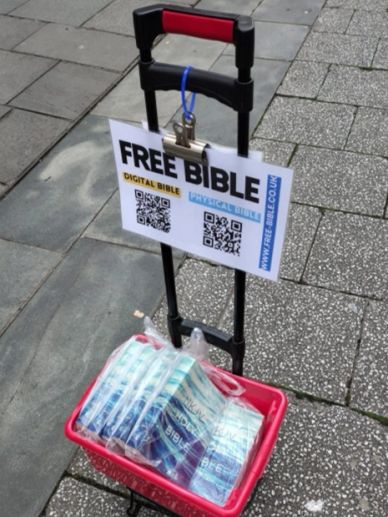
Every week we bring this box to Southampton to give away free bibles. There has been a huge interest, and we frequently wheel it away empty.
If you’ve ever tried to make a Swiss Roll you’ll know you have a time constraint. You bake the cake mixture on a flat baking sheet. But once you remove it from the oven you have a limited time to spread the filling onto it, and roll it. Leave it too long and it will harden and become less pliable. Cracks and splits will appear in it if you try to roll it.
You would then have not so much a roll but a crumple- like the Lulworth Crumple, in Dorset (picture on the contents page). This has many layers, originally all laid on top of one another. That must have happened when the rock was in a liquid state, because the layers levelled off horizontally under the influence of gravity. In due course they began to harden.
What we can see at Lulworth now is what happened when massive forces acted on these layers. Some were turned on their side by 90 degrees, and now run vertically. There is a great deal of fracturing, where the layers have split. It reminds me of the splits you’d get if you allowed your Swiss Roll mixture to harden before trying to roll it.
Walk a mile or so East, (when the army range walk is open) and you will see a chain of islets stretching out to sea. Each one has been tilted 45 degrees sideways by these massive forces.
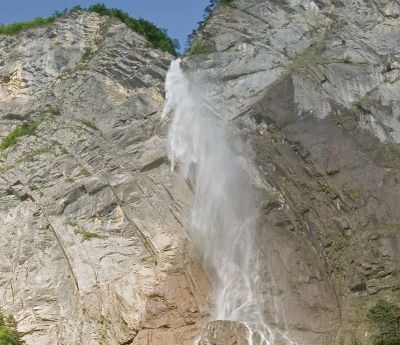
On a train journey through the beautiful Haute Savoie region of France to Geneva I glimpsed the amazing Cascade de l’Arpenaz (picture at the top of this page). What leapt out at me wasn’t the beautiful waterfall so much as the massive rock roll behind it. It too has been turned through 90 degrees and rolled.
What’s so striking about the Savoie Roll is how good a roll it is. Although there are some cracks, numerous layers have all rolled simultaneously to make a partial circle many layers thick. This could only have happened if those layers had been deposited within a short space of time of each other- so that none of them had yet become too hardened and unpliable.
You may have guessed where I’m going with this. The Savoie Roll was clearly subjected to these massive forces when its layers were more pliable than those in the Crumple. The obvious implication is that all of these layers had deposited on each other over a relatively short time. They had became somewhat hardened, or they would have flowed downwards when turned by 90 degrees, making the layers thicker at the bottom than the top. But they had not yet hardened as much as at Lulworth, and hence could be formed into this amazing curve without much cracking.
I am no geologist, but this makes me very suspicious of claims that sedimentary rock layers like these were laid down as a result of many separate inundations over a vast time scale. It seems far more obvious that they were laid down in one massive series of inundations which occurred over a short time. Successive waves of deposits built up the separate layers rapidly, before any of them had time to completely harden. Then massive forces acted to rotate and roll them. The Savoie Roll was rolled just in time, whereas the Lulworth Crumple was left a bit too late.
This seems to me an obvious piece of geological evidence for a worldwide flood, as described in the Bible. Layers of sediment could have formed very rapidly in successive waves over a short time period. The necessary massive forces could have been caused by the weight of all the water rising and then falling. There were clearly some massive forces at work as “all the springs of the great deep burst forth” (Genesis 7:11)
In short, God knows how to make an amazing multi-layered Savoie Roll. I wonder if He made it to demonstrate His power and handiwork to all who will see it.
1430 290626
This site does not promote any political party or viewpoint. However when people of any political persuasion make theological assertions it is important to evaluate them- because we want truth not trickery.
There has been a recent glut of theological assertions made by Donald Trump, officials in his administration, and various influencers in the USA. They have claimed God is on the American side in the Iran war. This has attracted strong criticism from the Pope. And there is now also a growing divide within MAGA itself about these assertions. Some claim that America’s actions in the Middle East are fulfilling biblical prophecies about Israel. But others, such as Tucker Carlson, dispute this.
In this article I seek to highlight some characteristics of biblical prophecy. My aim is to help us determine what, if any, Biblical prophecies are being fulfilled right now, in front of our eyes.
There are several hundred prophecies made about Jesus in the Old Testament, which we see fulfilled in the New Testament. In the second chapter of Matthew’s gospel we can see some of them being fulfilled in front of the eyes of people of that time. For brevity we’ll just look at one of them. But if you study others for yourself you’ll find these same characteristics are common to many.
Herod was about to slaughter all the baby boys, so God had sent Joseph and Mary into exile in Egypt, along with the baby Jesus. Then Herod died and the family returned- “…to fulfil what had been spoken by The Lord through the prophet, ‘Out of Egypt I called My Son’.” Matthew 2:15.
That seems a clear enough fulfilment of prophecy. God’s plan for Jesus was only a temporary exile in Egypt. Now He was calling His Son back to Israel . But turn to where God originally gave that prophecy hundreds of years before, in the Old Testament, Hosea 11:1- “When Israel was a youth I loved him, and out of Egypt I called my son.”
How many of those hearing this from Hosea at the time would have thought it was a prophecy of a future calling of their Messiah? They’d have understood it as the historical record of events that had taken place hundreds of years earlier. God had called the Israelites out of Egypt under Moses. And yet Matthew tells us this was also a prophecy that one day God would call His own Son, Jesus, out of exile in Egypt. So Hosea 11:1 was both a historical record, and a prophecy about an event that lay far in the future when Hosea received it.
And what do you think anyone at the time would have thought when they saw this ordinary carpenter and his wife and child travelling along the road from Egypt? I don’t think anyone would have given them a second glance, let alone heralded them as fulfilling Hosea’s prophecy.
And Two Thousand years later, would any of this have been obvious to us, unless Matthew, under the inspiration of God’s Holy Spirit, had explained it?
These characteristics are common in Biblical prophecy. Prophecy may be referring to more than one event or to a type of event that occurs more than once in history. And it may only become clear in hindsight when a prophecy has been fulfilled.
And so to the present day. Are events in the Middle East a fulfilment of Biblical prophecies in front of our eyes? Can we say God is on the side of the USA in the Iran war?
It is possible the Iran war heralds the imminent return of Jesus to judge the world. But it’s equally possible it’s just another fulfilment of Jesus’ prophecy in Mark 13:7- “When you hear of wars and rumours of wars, do not be frightened, these things must take place but that is not yet the end.”
So whilst I unhesitatingly condemn the wickedness of the Iranian government, I would be a lot more hesitant to declare that God is on the side of the USA. I would be even more hesitant to declare that the Iran war is hastening the “end”, however that’s envisaged- (some common interpretations of end times prophecies would require a longer article than this just to list them).
However here’s one prophecy I have no hesitation in saying is being fulfilled right in front of our eyes. 2 Timothy 3:1-5-
“But mark this: There will be terrible times in the last days. 2 People will be lovers of themselves, lovers of money, boastful, proud, abusive, disobedient to their parents, ungrateful, unholy, 3 without love, unforgiving, slanderous, without self-control, brutal, not lovers of the good, 4 treacherous, rash, conceited, lovers of pleasure rather than lovers of God— 5 having a form of godliness but denying its power. Have nothing to do with such people.”
With the exception of “disobedient to their parents”, which I can’t find anything to confirm or deny, every word of this prophecy is being more than amply fulfilled in front of our eyes in the person of Donald Trump. He has single-handedly brought “terrible times” on much of the world. In particular he has displayed he merely has a “form of godliness” by his acceptance of Paula White’s blasphemous pronouncements likening him to Christ (see the photo at the top). Then he gave his own religious Easter address, and promptly denied the power of godliness by threatening to destroy Iranian civilisation.
Of course Trump is not the first ruler to fulfil this prophecy in 2 Timothy. It’s been “the last days” ever since Jesus’ ascension into heaven. Since then there have been many emperors, dictators and ayatollahs who have fulfilled this prophecy, and shown themselves to be wicked. There have also been countless less well-known people who have been wicked (in fact we are all wicked, even if we lack the opportunity to do as much evil as Trump). But for the moment, what should we make of someone who is fulfilling this prophecy as fully as Trump is? What do we make of someone who claims to have a form of godliness, to be fighting on God’s side in this war, and yet who is so thoroughly wicked?
The last line of verse five tells the Christian what we should do- “Have nothing to do with such people.”
Dear American Christian voters, doesn't that include not voting for such people?
You may claim, as many do, that God is using Trump for His purposes as He used King Cyrus (see Isaiah 44 and 45). But the fact that God might choose to achieve His purposes through a wicked man does not excuse his wickedness. Judas was not exonerated for betraying Jesus to death because Jesus’ death has atoned for the sins of all who believe in Him.
Right now a number of former Trump supporters are abandoning him over the Iran war. If he remains true to form Trump will never admit to being at fault over the war, and continue claiming he's on God's side. But Christians know that whatever sins we have committed can be forgiven at the cross. We simply need to repent and ask Jesus to forgive us. He promises that He will. And then we can seek God’s will for the right way forward.
We need to pray that Trump does those same things- repents, asks for Jesus’ forgiveness and seeks the right way forward. Because Donald Trump desperately needs to know actual godliness, not just the mere form of it.
1230 110426

The butterfly’s life cycle poses an infinitely knottier problem than the chicken’s. A butterfly emerges from a pupa. As soon as its wings are inflated and ready it can fly perfectly,. Last year we spent at least an hour in the Wye Valley Butterfly Zoo, and didn’t spot a single mid-air collision or crash landing. And yet no flying instructors or air traffic controllers operated in that artificially restricted and overcrowded airspace.
This is quite extraordinary. Because the butterfly entered the pupa stage as a flightless caterpillar. In the pupa it underwent a total metamorphosis, controlled by DNA instructions. Those included coding to build every body part, the skills required to use them, and all the other information needed to be able to fly.
That pupa required a caterpillar- whose body had to contain all those DNA instructions to know how to completely break down and re-assemble itself into a butterfly.
That caterpillar required an egg, also with all that DNA. That egg had to be carefully laid on the correct type of food leaf, so the infant caterpillar could emerge to eat and grow large enough to enter the pupa stage.
But of course that egg required a butterfly, able to fly competently, to mate, and to know where best to lay it.
And that butterfly emerged from a pupa- so we’re back where we started.
Which of these four stages came first, in order that the others might somehow evolve from it? That’s a nonsense question- the DNA instructions for all 4 stages of the life cycle must have come first, in order for any one of the four stages to exist. It’s a closed loop. No butterfly, pupa, caterpillar, or egg could ever have come into existence until all of that DNA coding had been written. And that raises this question- who wrote it?
The Bible sheds light on that- “Worthy are You, our Lord and our God, to receive glory and honour and power; for You created all things, and because of Your will they existed and were created.” (Revelation 4:11)
1655 020426

We have plenty of candidates for our greatest problem. If we just limit ourselves to problems starting with P the list includes Pollution, Poverty, Pandemics, and Propaganda (deepfakes, etc.). At the top of many people's P list at the moment is Presidents- specifically Presidents who abuse their power. But by far the greatest Problem we face is the one many people are in denial about- Perishing.
Many in the UK make their wills and pay for their own funeral in advance. They prepare for the inevitable end of life in this world. But they do nothing to prepare for what will follow- the resurrection of the dead to eternal life or to eternal Perishing.
The Bible sheds light on this. In John 3:16, Jesus says- "For God so loved the world that He gave His only begotten Son that whoever believes in Him should not perish but have eternal life." This is not a promise that believers in Jesus will never die, but that they will be raised to eternal life when He returns. Perishing is the opposite of eternal life, it’s eternal death.
Elsewhere Jesus explains that eternal death doesn’t mean the absence of any life- e.g. annihilation. Rather it is an eternity of conscious punishment in Hell for those who have refused to believe in Jesus. Perishing will be such an appalling eternity that no one in their right mind would want to face it. All the other P’s will cease on the day Jesus returns to bring about perfect justice. But God knows Perishing is our greatest problem, because He gave Jesus to save believers from it for all eternity.
Avoiding Perishing is not complicated- Jesus says, “believe in Me”. That means more than believing He died in our place to pay the price for our sins (although that’s the starting point). It means trusting in Him totally and following wherever He leads. It’s not about being religious or doing good works to try and earn salvation. It’s about depending on His love poured out for us on the cross. And the great news is that Jesus says “whoever” believes can be saved from Perishing. No one is excluded.
1655 020426

In February 2025 I submitted the letter below to “Evangelicals Now”. It was published under “Your Views” in their online edition. 20 months later, criticism of Trump by his “base” is finally becoming less muted, but has by no means matched the pace of his (predominantly) cruel, illegal, and ignorant actions. Society’s “fig leaf of decency” has withered even more rapidly, as Trump himself has set such an indecent example. It is now even more urgent to pray for Trump to repent, and for Americans to vote wisely at the mid-terms.
Many people around the world will assume that Trump and his acolytes represent genuine Christianity. So Christians in those places will suffer increased persecution as a consequence. People will take out their hatred of Trump on Christians. It seems to me that far too many American Christians have been reluctant to disassociate themselves from Trump. For the sake of the gospel and our suffering brethren, I would urge all Christians to put plenty of clear blue water between ourselves and the Trump Administration.
Donald and the Fig Leaf (February 2025)
I hesitate to write anything about Donald Trump as it may quickly become out of date - he is proceeding at a frenzied pace. So I’ll remind readers of three assertions which were made about him long before the 2024 election. These are just examples, there are many others.
Firstly, Trump lies on an industrial scale (his false claim to have won in 2020 caused an insurrection). Secondly, his sexual immorality has long been public knowledge. Thirdly, it was asserted that he regularly cheated the contractors who worked on his properties (see James 5:4).
Facing a lack of criticism
Even though he was clearly unfit to hold office, a majority still voted for Trump in 2024. The possible explanations for this have been discussed at length elsewhere. Since his victory it’s no more surprising that Republican politicians stick by him than Democrat politicians and their voters condemn him.
But what’s much harder to understand is why Republican voters have, to the best of my knowledge, made very little criticism of him since his election. In a breathtakingly short time Trump has undermined the rule of law and ruined the reputation of a great country. He’s made only modest progress, if any, on the issues his voters elected him to tackle. If he were my President I’d be deeply ashamed of him.
Are you praying for Trump?
But I have done much I’m ashamed of. I too have been guilty of lying, sexual immorality, cheating, and more. But wonderfully I can praise God that Jesus died to pay for these and all my other sins. I can praise God that His Holy Spirit gives me power to overcome sin every day. And I know that unless a person turns to Jesus in repentance and faith they will remain as enslaved to sin as I was. So I shouldn’t be pointing out anyone’s sin without praying that they too find forgiveness in Christ. Are you praying for Trump?
Maybe Trump’s voters can’t bear to admit that they are ashamed of him. But let’s not forget that most of them are not converted. Trump has had the money and opportunities to sin more grossly and publicly. But that apart, unconverted people can feel a sense of solidarity with him. And why should they be ashamed of Trump’s sins, if they’re no impediment to being elected to the highest office in the land?
If the extent of such a solidarity among sinners still seems an inadequate explanation for Trump’s enduring popularity, then let me make two final observations. Firstly, Jesus warned us that few find the gate to life, and most are on the broad road to destruction. Jesus’ warning also applies in the USA, despite its high rate of church attendance. Secondly, society on both sides of the Atlantic has become increasingly anti-Christian. So should we be surprised when the fig leaf of decency covering people’s sinful nature gets flimsier?
Posted on this site 1440 011026

As you can see in our article “Do I know what you’re thinking?” belief in the reality of Heaven and Hell is at a low ebb today. And yet if you walk into St Thomas’ church Salisbury you will be boldly confronted with both, in this massive Medieval Doom painting.
Does this simply prove how unenlightened Medieval people were? We can be tempted to think that all of our scientific and technological progress makes modern society more enlightened than anything that has preceded it. But there's a surprise here for anyone who thinks the truths that inspired this famous doom painting are as unsophisticated as its “primitive” painting style.
This doom painting is believed to date from 1475. However, it was whitewashed over in 1592, during the Reformation. It was not rediscovered until 1819, was restored in 1881 and then re-painted in 1953. It spans the entire chancel arch. If you are ever in Salisbury city centre it is well worth a visit.
Dominating the scene is Christ Himself, sitting on a rainbow above His twelve apostles, and flanked by the Virgin Mary and John the Baptist. We see the cross and crown of thorns. The occasion is clearly the day of judgment, when Jesus returns to raise all the dead and judge them.
On the left-hand side, as we view it, we see the Christian dead being raised from their graves as the angels sound their trumpets. They are then welcomed into the heavenly mansions. They are naked- probably to show that they contribute nothing to their salvation and are all equal in Christ.
On the right we see a defiant devil-like figure, with one foot on the arch itself. To his right a woman appears to be offering him a drink. It is speculated that this may depict a notoriously wicked local innkeeper. Just above her, unrepentant sinners are trying to block out the sound of the trumpet. They are being raised to life, only to be herded by demons into the mouth of a monstrous hellish beast and into fire.
You can see that even being a Bishop, or a King, is no guarantee of salvation. Including such characters was a remarkably subversive thing for the painter to have done, but with Biblical warrant (see Revelation 6:15-17). The only writing on the painting, at the extreme bottom right, says “no escape for the wicked”- in Latin. It doesn’t matter what your earthly status is. Mere status cannot save you on judgment day. We recently met a retired priest in Southampton who was bold enough to declare that he knew he was going to heaven simply because he was a priest. We tried to challenge his mis-placed confidence.
The fact that this is the only writing on the painting reminds us that most of St Thomas’ Medieval parishioners were probably illiterate, and the services would be held in incomprehensible Latin. So, the purpose of the Doom painting was to confront people visually with the reality of the day of judgment and the truth that there are only two final destinations- Heaven or Hell. Interestingly, although the fictional concept of purgatory was (tragically) all too well-established at this time, the painting doesn’t seem to show that. There are only two final destinations here, and the unbridgeable chasm of the chancel separates them.
The Reformers were wary of pictorial representations of Christ, and would probably have also objected to the prominence given to Mary and the Apostles, and their haloes. The great aim of the Reformers was to restore the Bible, God’s Word, as the central focus of the church. They didn’t want people’s beliefs to be based upon an artist’s imagination, but on God’s revelation in Scripture. They didn’t want people with haloes, or priests claiming the monopoly to dispense salvation via mysterious rituals in a foreign language.
In short, the Reformers wanted people to be truly enlightened by hearing the Bible taught in their own language. Once that was happening such paintings as this would be shown up for what they are- very limited and usually flawed pictorial representations of things the Bible fully explains in words. In due course, under the Reformation, many of St Thomas’ parishioners would have learned how to read these things for themselves.
In 1592 someone got out what must have been a very large barrel of whitewash and covered the painting. It may have been that they valued it highly and wanted to hide the painting from Reformers who might have destroyed it- as they did with many images and statues elsewhere. But it may have been that the people of St Thomas’ had come to the conclusion that the painting was now obsolete and inadequate, given that they now had access to the Bible. I hope it was the latter!
However, having found fault with various aspects of the painting, here's the surprise. I think its Medieval artist was in some ways more enlightened than we might give him credit for. Unlike so many today, who are in denial about life after death, he faced it head on (See our article “Our greatest problem” about people in denial about death). Above all, his doom painting, is not a gloom painting. Heaven, and its Lord dominate the space. Jesus is the Victor. His people are heading for Heaven. The devil and Hell are only afforded a much smaller corner as defiant but defeated foes.
Once or twice recently people have shouted out “Christ is King” or something similar, as they see us preaching in Southampton. They don’t often stop or explain what they mean by that, and we are all too well aware that this has become a slogan used by White Supremacists, and those who hate Moslems, amongst others. We oppose all such ideas. “Jesus is Lord” is not a political slogan, it affirms what the painting attempted to show- Jesus is returning to raise all the dead and judge the world. God’s purpose is that “in everything Christ might have the supremacy” (Colossians 1:18).
We cannot be gloomy about that, because it means every injustice will be righted, every victim will get perfect justice. And those who have repented of their sin and trusted in Jesus will be in glory with Him for all eternity.
Christ’s cross is not as prominent in the painting as I’d like, but His wounded hands and feet are clearly depicted. And as a friend recently pointed out to me, those wounds will be the only “imperfection” in Heaven if we can call them such. So, to balance “no escape for the wicked” the painter would only have needed to add 4 more words here, in English, “Pierced for our transgressions.” That comes from the Old Testament- Isaiah 53:5. It tells us that all who turn to Jesus will have all their sins forgiven, because He paid the price for them in full on the cross. That truly is news too good to be whitewashed over!
0930 010526

This image did the rounds on social media in the summer of 2025. It purported to show President Macron of France, and other European leaders, lined up like humble supplicants outside Donald Trump's office. It doubtless enraged many Europeans, and encouraged MAGA supporters. However, unless President Macron has grown an extra pair of legs, you can see that the image is faked. This line-up never happened.
Increasingly sophisticated AI is making tell-tale glitches like this much less common. We have now reached the point where so much is faked that it is impossible to trust much of what we see, hear or read online. And yet many people claim they get their news solely from whatever their social media algorithms put in front of them!
Of course newspapers and TV stations can be biased and selective in what they report. But at least media outlets like the BBC run fact-checking departments, to try and make sure they don’t simply regurgitate the lies and deceptions which clog the internet.
In this sea of fakery it's more urgent than ever to know whose words we can trust. So it's wonderful to know that there is Someone Who always tells the truth - Jesus Christ. He says, “I am the way and the truth and the life.” (John 14:6). And we read, “It is impossible for God to lie,” in Hebrews 6:18.
Jesus will never deceive us. He will never go back on His promises. And because He is God He will never be forced to go back on them because of unforeseen circumstances or “force majeure”. We can depend on Him absolutely to do what He has said He’ll do. Isaiah 55:11 says, "So will My word be which goes forth from My mouth; it will not return to Me empty, without accomplishing what I desire, and without succeeding in the matter for which I sent it."
Furthermore, Ephesians 3:20 tells us He is, “able to do far more abundantly beyond all that we ask or think, according to the power that works within us.”
Who is the “we” and the “us”? It’s all those who have put their trust in Jesus. They believe He only speaks the truth. They believe He is Almighty God, capable of keeping His promises no matter what. And they know that Jesus doesn’t just care for them, He loves them. He kept His promise to save them, even though it cost Him the unimaginable suffering of the cross.
If you can't trust Jesus, then who ever could you trust?
1655 020426

One of the talks I give in Southampton is entitled “What people often say to us”. It distills many conversations in the street down into three opinions we often hear. Perhaps you might hold one or more of them?
We often hear people say, “I’m a good person”. Sometimes we ask people to place themselves on a scale from 1-10, with 1 being evil and 10 good. Some people have claimed to be a 10! But most people rate themselves as pretty decent- perhaps 7 or 8.
What does God say about that? In Mark 10:18 Jesus says- “No one is good- except God alone.” We are all guilty sinners.
Now if that’s true, then another thing people say comes into sharp focus- “There’s no heaven or hell.” This is the practical religion of most people in the UK who say they’re not religious. They hold it as an article of faith that there is no God, we’re just here by blind forces of chance, and when we die that’s the end of us, So we might as well live as we please and do whatever we want.
God’s answer to that is in 2 Corinthians 5:10 “We must all appear before Christ’s judgment seat.” It doesn’t matter what our opinion is about life after death, this is the reality. Everyone will end up in one of two places, heaven or hell. And unless you’re a perfect 10 you can’t enter heaven. “Nothing unclean, and no one who practices abomination and lying shall ever come into it.” Revelation 21:27. No one can make themselves a perfect 10 by their own efforts. But don't despair- read on!
The final thing people say is the most common, “I don’t need Jesus Christ.” This doesn’t even need to be articulated. All someone needs to do is to walk on by the preacher, shouting out an insult, or rolling their eyes.
But anyone who thinks they don’t need Jesus must reckon with Romans 5:8- “While we were still sinners Christ died for us.” Why would Jesus have done that if we didn’t need Him? Why would God send Jesus to die pointlessly? He wouldn’t have. God sent Him to die for us sinners because, as Acts 4:43 says, “All who believe in Him receive forgiveness of sins.” Forgiveness of sins means we become a 10, and can enter heaven. It means that when we die we don’t need to fear the judgment. We know we’ll be in glory with Jesus for all eternity.
The other day in Southampton I heard a passer-by say to her friends, “People shouldn’t push their belief on to you, they should let you come to them.” I’d have every sympathy with her if we actually had been “pushing”- being aggressive or argumentative. But we weren’t.
I didn’t get to speak to her, but just perhaps I know what she was thinking, if she's like so many. She may be thinking she’s good, or that there’s no judgment to come, and she doesn’t need Jesus. But false beliefs like that will have dreadful consequences for all eternity. How can anyone who knows the truth keep quiet about this? "How will they hear without a preacher?" (Romans 10:14)
(1655 020426)


Not far from the woods on our header page, in Derbyshire's White Peak, lies the ancient stone circle of Arbor Low. Its builders and purpose are unclear, but we may presume it involved un-enlightened religious beliefs. In contrast ArborHigh exists to enlighten by bringing Biblical wisdom to bear on vital issues that concern all of us. AI helped design and build the website. It also keeps on offering to write it for us, but we will keep on refusing that help. The only AI generated text on this site will be Almighty Intelligence- that is God's wisdom from the Bible.
